When it comes to skills with defensive firearms the skills that you have on the range are one thing. The skills you can rely on in a sudden moment of truth in the real world are what you will live or die based on. That I place a premium on these skills was noted in a recent article I published in these pages.
That premium is rooted in my own experiences and how I have trained over the decades. It has been reinforced by mentors like Tom Givens. A Greek poet of the Archaic era, Archiolocus, is noted for saying…
“We don’t rise to the level of our expectations; we fall to the level of our training.”
That simple bit of wisdom remains in use with trainers at all levels, up to and including elite military units. When that thought is coupled with the human tendency to overestimate our knowledge or ability, the Dunning-Kruger effect, the point becomes all the more clear. Without good training, initial and periodic refresher, the gun you’re carrying is more of a liability than it is life saving equipment.
Training, or the lack of it
Beyond an initial concealed carry license class, and those are becoming less prevalent in states that have moved to permitless, or constitutional, carry, private citizens very rarely do any actual training. They may fire a few shots once in a while on a casual range trip, but just as often many don’t fire at all, let alone train. Those who do often try to shoot beyond their ability, perhaps in search of an ego boost, and their results on target are rarely good. Even relatively good shooters who carry when working on their own, in my observation, do not often train with a real purpose, with specific goals or under constraint.
In law enforcement, whose members are by definition “armed professionals”, reduced training budgets and a general shift in mindset away from viewing firearms as critical path equipment to more of a tool, or even a burden, that must be carried have taken a toll. Hit rates in officer involved shootings generally hover at 30 to 35% of total shots fired, even in well trained agencies. Qualification exercises are often more about checking the “been trained” box, than they are about evaluating the skills an officer is going to need to call on in a gunfight.
Finding a better way
Over the years there have been trainers who’ve stressed the urgent, and uncompromising need for hard coded, fully myelinated, cold skills. I’ve drunk deeply from their intellectual punchbowl. But much of today’s gun community at large doesn’t know of them, even though so much of what they have taught infuses what the average shooter does, whether they recognize it or not.
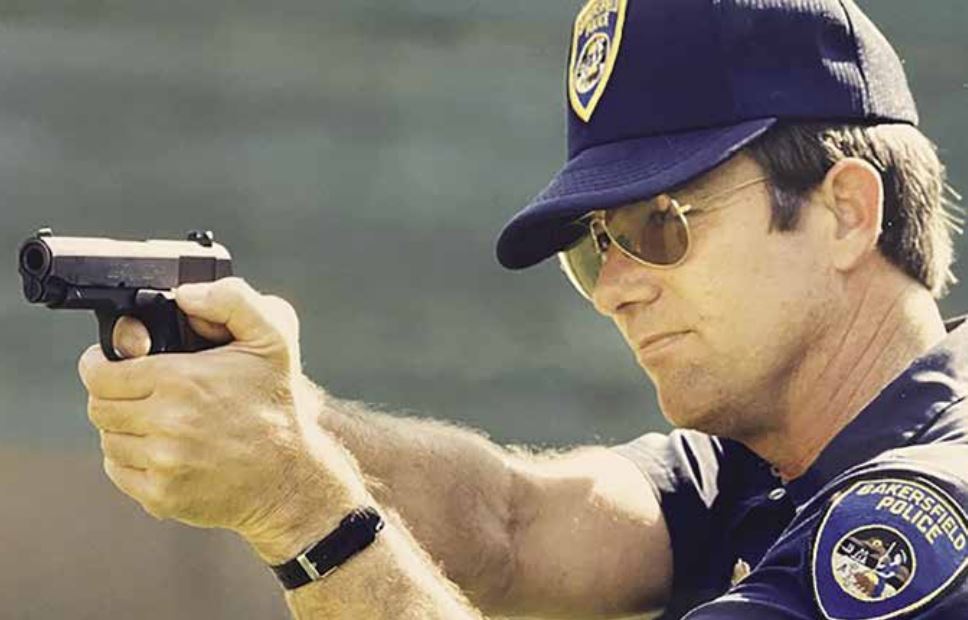
One such person was the late Mike Waidelich. He was a trainer and rangemaster at Gunsite for many years. He had been a combat soldier, a Green Beret who deployed. After the military he entered into a 30 year law enforcement career during the troubling times of 1967. As Bakersfield PD’s firearms instructor for 17 of those years he was given a mandate to correct utterly abysmal performance by officers in real world shootings. In one year, BPD officers were involved in 8 shootings and did not hit their intended target with a single bullet in any of them.
Clearly, cold skills in a sudden confrontation were lacking.
Waidelich, with the blessings of the brass, developed a training program for the academy and for in service officers backing it up with a demanding, but fair, ten round qualification course which had to be passed with a score of 80 or better on demand at any time. The hit rate in officer involved shootings there went from zero to 85%.
You can read more about Mike Waidelich and the history here, and here.
After Waidelich passed away in 2021 his name and his teaching came back into the consciousness of gun culture thanks to trainers like Andy Stanford, James Yeager and Bob Jewell. There was a proliferation of interest in the Bakersfield Qualification exercise. Articles were written, videos were made. And then the lessons seemed to be mostly forgotten again. No longer the new, shiny penny of the Gunternet, as I call the online shooting community, the lessons of Bakersfield once again seem destined to fade away.
But, with slight modifications, Bakersfield PD still uses the exercise to this day, and their firearms training is crafted to support it. Officers are required to fire it quarterly, with three tries, and their average score of the three runs becomes their qualification score.
Firing the exercise
The current course of fire for Bakersfield PD, using a USPSA / IPSC target scored 10 / 9 / 6, with 100 points possible, is as follows:
• Stage 1: Two rounds at 10 feet in 2 seconds
• Stage 2: Two rounds at 20 feet in 3 seconds
• Stage 3: Two rounds, combat reload and two rounds at 30 feet in 7 seconds
• Stage 4: Two rounds at 60 feet in 4 seconds
A passing score is 80 or better. As I don’t ordinarily have turning targets available, I simply score any hit over time as a miss. The exercise is intended to be fired from secured duty gear, but it can be done from concealment as well.
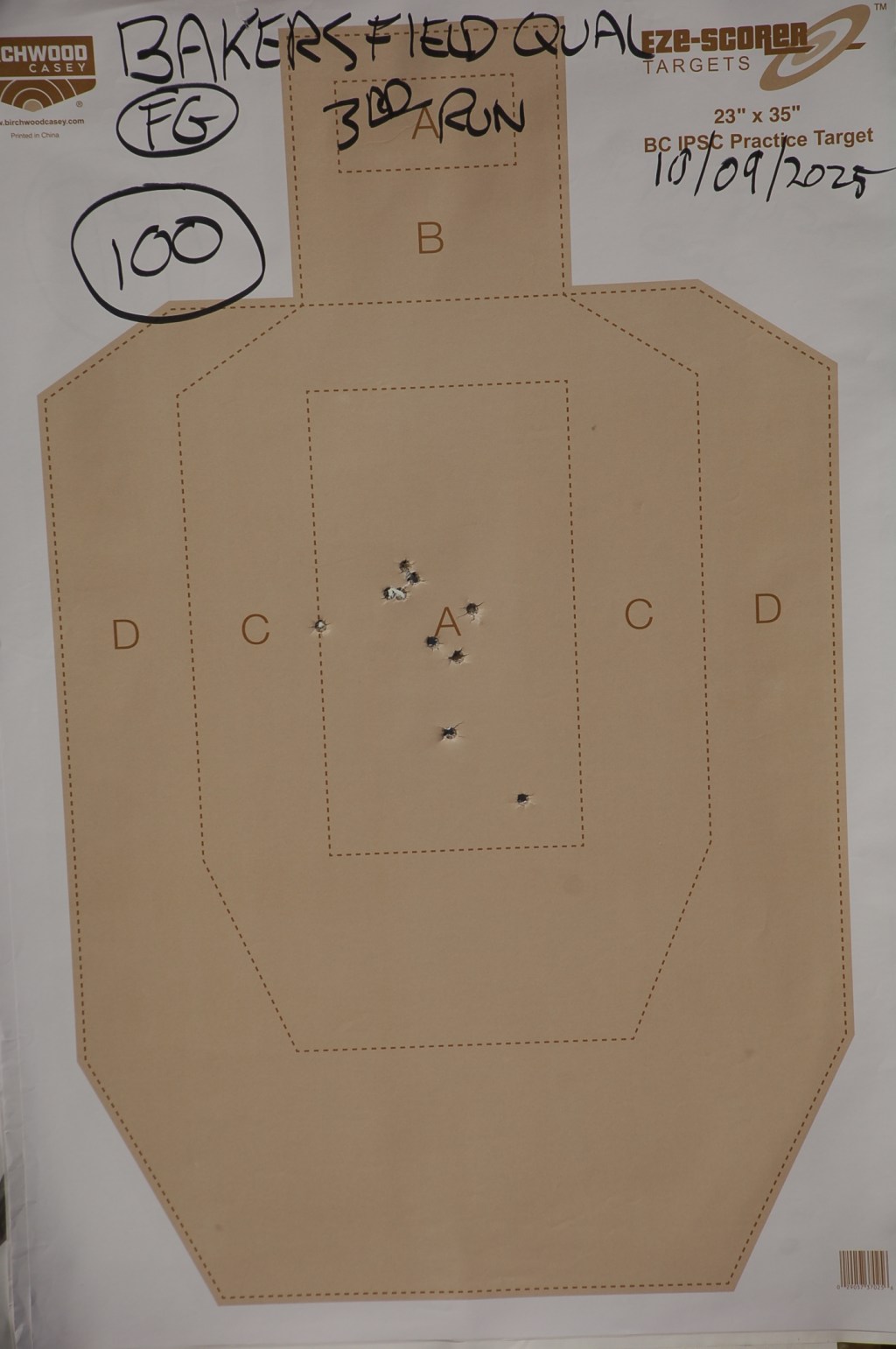
Using the facilities of Gillette Gun Club, I ran the exercise three times with a Gen 1 Smith & Wesson M&P 9 in a Safariland ALS holster. My average across the three runs was 94.3%, and I pulled a score of 100 on the third run. All 12 stages were executed within par.
Findings and future work
The course of fire is still viable and reflective of real world situations where officers are most often called to defend themselves unexpectedly and without warning. As many private person defensive encounters are also sudden and frequently come because the defender was not paying attention to their surroundings, the exercise makes a solid test of skills for them as well. As I note in the accompanying video an armed professional who cannot meet the minimum score, within par, using their duty gun and duty gear, needs high value training quickly.
With a benchmark established, I am interested in evaluating the exercise against more demanding targets to build precision. The teaching of Dr. James Williams in his Tactical Anatomy Systems course work makes clear that pistol bullets need to be placed precisely into anatomically significant places within the body to produce rapidly incapacitating damage and make whatever is threatening our life in that moment stop doing it.
Over the coming months I am going to experiment with a number of different targets with smaller preferred areas than the 12 inch by 6 inch A zone of the IPSC target. Can progressively reducing the size of the area to be hit drive a higher level of precision at necessary speed? It can, of course, for a high level shooter. But can it for someone who doesn’t train or practice as much as they should?
Stay tuned.
Photo credits :
Man shooting pistol sourced at KeepGunsSafe
Mike Waidelich photo sourced from USCCA newsletter July 2024 published at Firearm Trainers Podcast.

 SRF Training and Consulting LLC
Leave a reply to 18 Rounds – SRF Training and Consulting LLC Cancel reply