The reality of using firearms for lawful self defense is that when you need them you are not going to have time to get ready. You are going to have to perform at an elevated level, with no preparation, or you might not win. Not winning, in that context, creates really bad outcomes.
Violent attacks, whether perpetrated against a private person or an armed professional like a peace officer, come without warning. They are nothing like the exercises that you fired when you took your carry license class if that class even included live fire. An armed professional will not have time to set up in their favorite gunfighter crouch, prep their holster and wait for the whistle like they do when they fire for qualification.
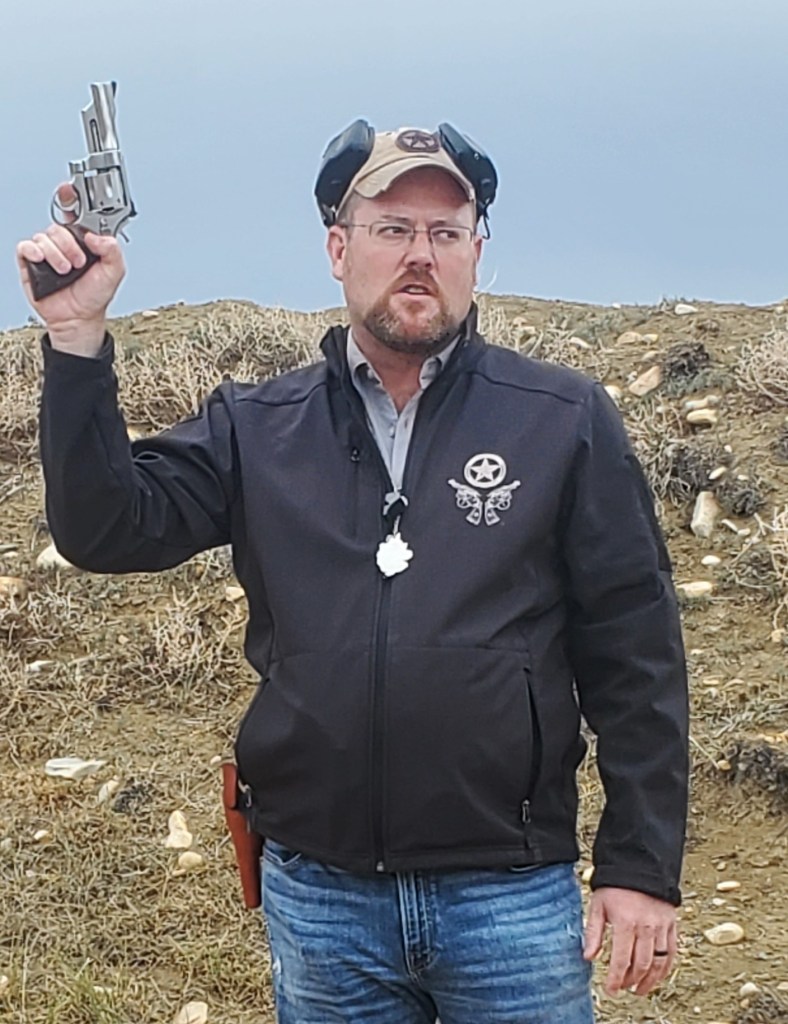
Qualification exercises that some shooters periodically fire are often not much of a test. And invariably they are fired at the end of a training day, not the beginning. We have seen repeatedly where experienced officers, who regularly pass their agency qualification, fail to get hits in the real world when not getting hits can cost them their lives. When we consider the majority of private persons who do not shoot a lot and actually train less, the gap between surmised performance and actual performance becomes as wide as the Grand Canyon. As my fellow traveler and noted trainer Bryan Eastridge of American Fighting Revolver, at left, wryly observes, “If you need to “warm up” to pass a qualification, you’re not qualified.”
To be able to resist an armed attack at a necessary skill level requires work. And it requires putting your skills to the test periodically under as much constraint as you can safely muster. This is why I like to collect drills and exercises that I can shoot periodically, and run students through, which evaluate available skills on demand. Those are the skills that save lives, and the life we save may indeed be our own.
I prefer to use exercises that can be fired with either a pistol or a revolver as I teach, and use, both An exercise that a student can step on to the range with their carry gun in their carry gear, that tests and reinforces skill while surfacing areas of improvement is my goal. I wrote an article for the Snub Noir blog a few years back on low round count, high training value drills as part of my continuing pursuit of such tests. It’s worth a read if for no other reason than to add to your own collection of worthwhile exercises.
One example of such a test was designed in the 1970s by the late Mike Waidelich for his then employer, the Bakersfield Police Department. They still use it today, with some modification, and Karl Rehn wrote on it in his blog earlier this year. I like to fire that exercise at least a couple times a year.
For this week’s range session, I decided to start with the ASP 10 Round Skill Test. Designed by John Correia of Active Self Protection this 10 round exercise looks deceptively easy on paper. But firing it cold, and at speed, is where the learning lives. I had not fired in a full week, and at last week’s session I ran just 25 rounds so one could say that what ever on demand skill I had would be put to the test.
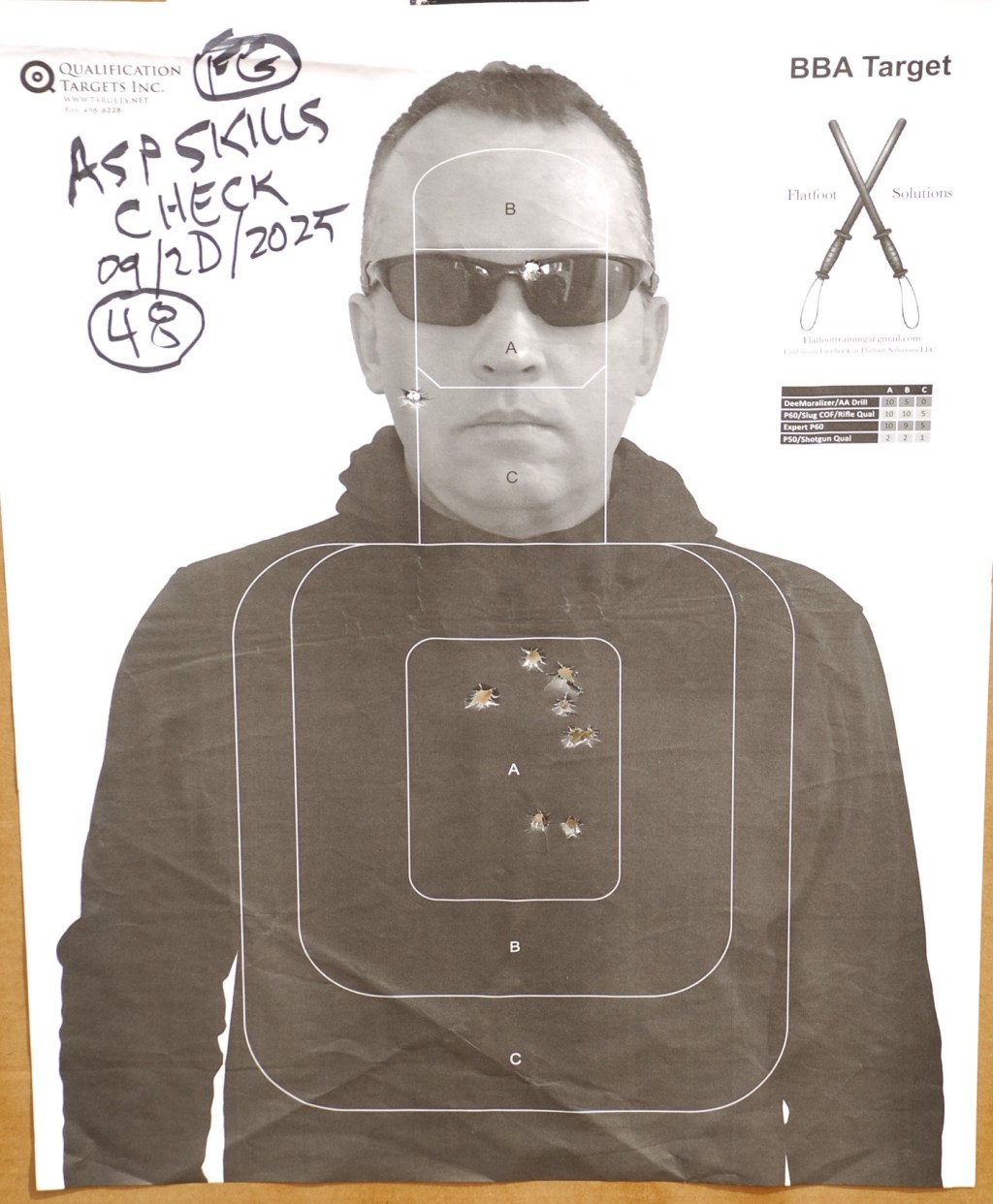
To give it a bit more spice I substituted out the USPSA / IPSC target that the exercise calls for with a BBA target designed by my friend Nick at Flatfoot Solutions LLC. Nick is a working cop and a solid instructor. He has also “seen the elephant” in the real world which helps to inform his experience. Like me, Nick looks for smaller targets to drive the student to really focus on attaining fight shortening hits. In the case of his BBA not only did he reduce the size of the image, but the scoring areas are reduced as well. Where the USPSA target uses a 12 inch tall by 6 inch wide A zone on the chest area, the BBA uses a rounded off rectangle that is just 4 inches by 6 inches. In scale it represents where we need bullets to go in a defensive context well.
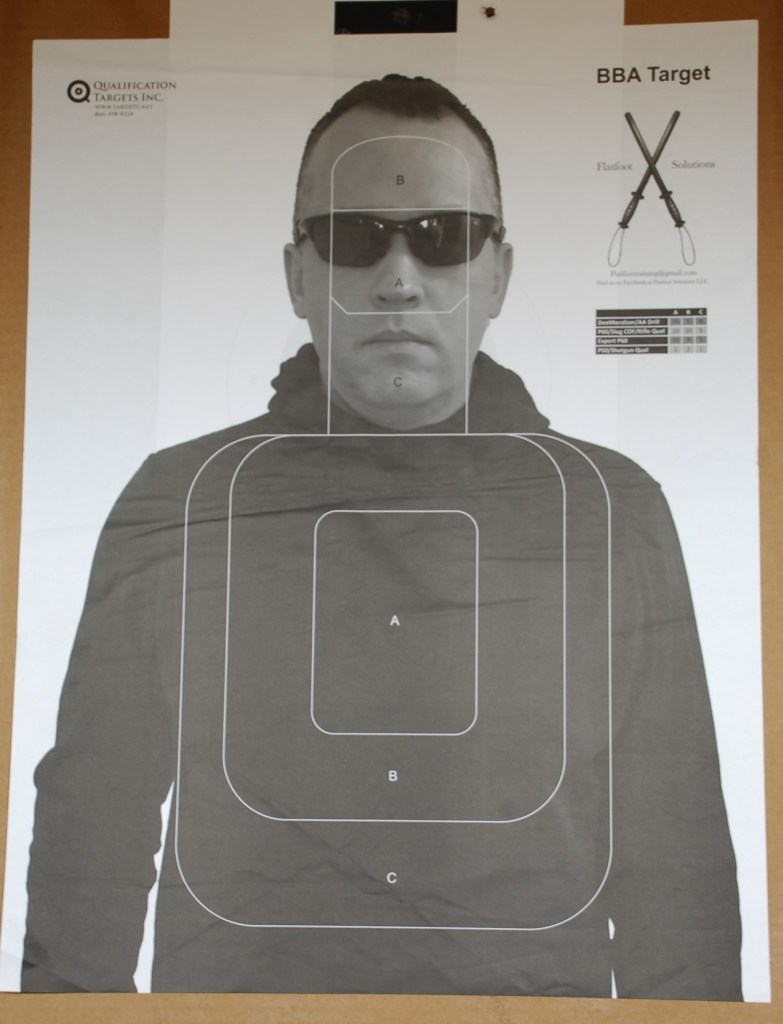
I had fired the exercise three times on a range session several weeks ago to get a feel for it. I did not try to push speed and my average times per stage were 2.19, 2.04, 2.79, 4.33, with clean scores on a USPSA target. For today’s cold run, using an M&P9 Compact from concealment I picked up the pace a bit. The times per stage were 2.00, 1.94, 2.54 and 3.31, all below the previous averages. The video below from our You Tube channel documents.
I dropped 2 points with a marginal C zone hit on one of the two head shots, otherwise everything was solidly in the A zones for a raw score of 48 points. Dividing the points by the total time of 9.79 seconds gave a result of 4.90. Multiplying that by 12.5 yielded a final score of 61.28. In all a satisfying performance for me, and indicative that I have cold skills that I can count on if I have to. But those skills are perishable, and they need to be polished periodically or they will disappear.
A final thought… the Flatfoot Solutions BBA target is a winner. My friend Nick has designed a particularly useful target that checks a lot of boxes for me and should for other trainers. The only quibble I have is that the scoring overlay is too visible for my taste but given the audience and the drills it was created for the target is just fine. It is available from Qualification Targets Inc.

 SRF Training and Consulting LLC
Leave a reply to Cold Skills are the Best Skills | The View From Out West Cancel reply