
We spend a lot of time when training defensive shooters, both armed professionals and private persons, to achieve hits at speed on 6 to 8 inch areas on flat silhouette targets facing us. That accuracy standard is not necessarily a bad thing, but it really only scratches the surface of what we should be teaching.
I have long advocated, as have some others way above my level as an instructor, that we need to be more focused on smaller areas to deliver fight stopping hits. This is particularly true when handgun bullets are involved as the well-known performance limitations of those projectiles. But we also need to get out of the mindset of two dimensional targets that always face us squarely. The real world is three dimensional and everyone in it is relentlessly in motion. To that end we have to be able, if the need arises, to put bullets into a 3 to 5 inch area from any angle or view.
To that end, I recently attended a two day instructor development course presented by Tactical Anatomy Systems titled Shooting with X-Ray Vision, abbreviated as SXRV.
A little background
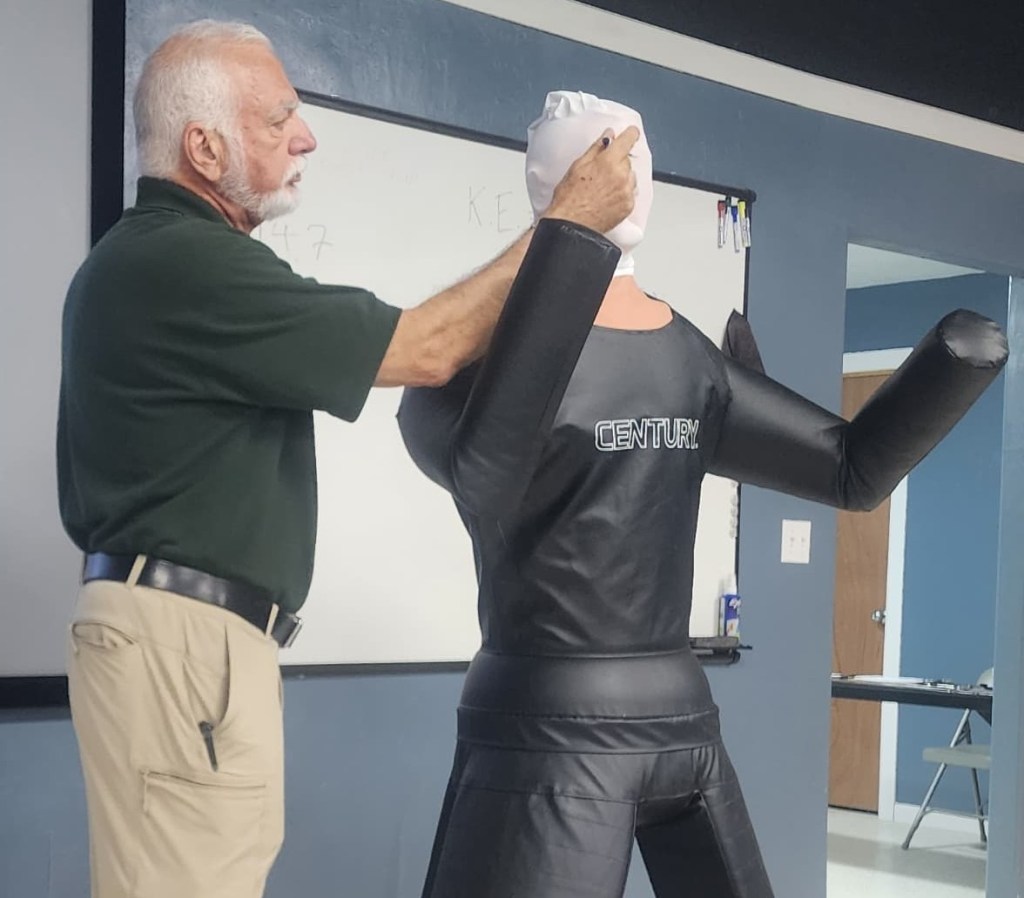
Tactical Anatomy Systems was launched three decades ago. Its founder, Dr. James Williams, is an emergency room physician and former law enforcement officer who has also been a SWAT medic. Doc, as he is known to most, developed his methodology based in his experience and observations of hundreds of gunshot wound cases as well as his experience as a lifelong hunter. He has been a staff instructor for Massad Ayoob’s Lethal Force Institute and a multiple IDPA state champion as a competitor.
Doc observed what he describes as deficiencies in law enforcement firearms training and tactics, then developed his methodology from them. Emphasizing precise delivery of fire by visualizing internal body structures and not relying on external body landmarks was the key. Agencies that adopted his methods have reported significantly improved outcomes in lethal force applications. To that end Doc created a “train the trainer” course for both law enforcement and private sector trainers.
I have known Doc online for a number of years, and had seen him speak during the Pat Rogers Memorial Revolver Round Up at Gunsite a couple of years ago. His instructor course is one I had wanted to complete for a while.
TD1
Twenty three students, instructors all, gathered at the Meadhall Range in McLoud Oklahoma at 0730 on Saturday morning. After administrative tasks and introductions were out of the way we dove headfirst into the curriculum. The approach through out was grounded in adult learning theory, with give and take of feedback strongly encouraged. The subject matter can often be explicit, but vital, so it is not to be taken lightly.
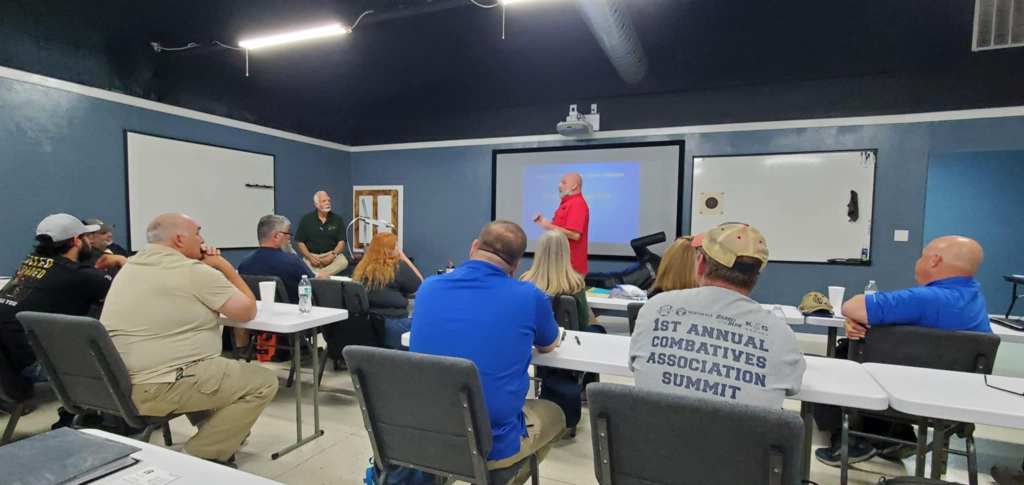
Doc emphasized a point up front that when it comes to a gun fight, if you are forced to engage in one, the overarching tactical imperative is “kill or be killed.” When justified we are trained to shoot to stop the threat, but that must be couched in understanding that stopping the threat necessarily implies that death will likely be the result. And that if we fail to stop the threat, then we will likely be killed.
The objectives of SXRV are to provide realistic and practical training for armed professionals and armed citizens in both the art and the science of effectively shooting bad guys. Our objective as instructors was to prepare ourselves to teach the techniques as part of advanced training in the lawful use of deadly force to our students.
A key element in the first day’s lecture was “Prevention of FTN” with that acronym meaning Failure to Neutralize. Using real world examples of law enforcement fights where a shot perpetrator was not stopped immediately even though the guns and bullets worked as intended, the takeaways fell to officers failing to fight as trained or failure of the agency to train realistically. That transitioned into 3D modeling of human anatomy so as to identify those small areas where our bullets will have the best and most immediate effect.
This block was a nice validation for me as I have been working with progressively smaller preferred areas, like 3×5 cards, Post It notes and two inch dots in my curriculum. Shooting to those smaller shapes is, clearly, the kind of accuracy we need to train to when it comes to necessarily shooting living creatures. Adding the third dimension is where the light bulb moment was. In this respect one of Doc’s observations was spot on… once you visualize it in 3D you can not help but to see it that way.
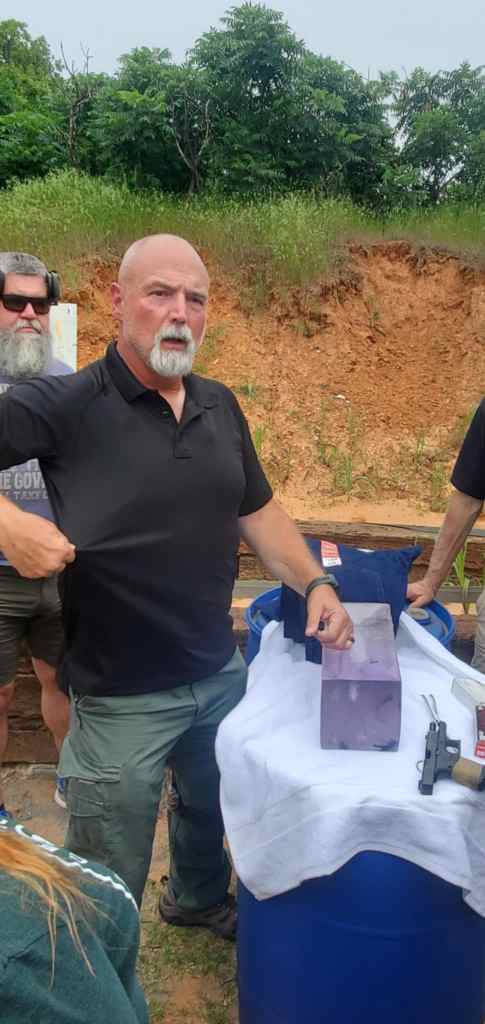
We spent part of the afternoon on the range for ballistic gel testing demos facilitated by the Legendary Lawman, Chuck Haggard of Agile Training and Consulting. We were able to observe common use handgun, carbine and shotgun ammunition fired into test media covered with four layers of denim. This type of testing, it must be stressed, is not a direct analog to the human body. The real benefit of gel testing is that it provides a consistent testing media that removes the media as a variable and allows apples to apples comparisons of bullet performance.
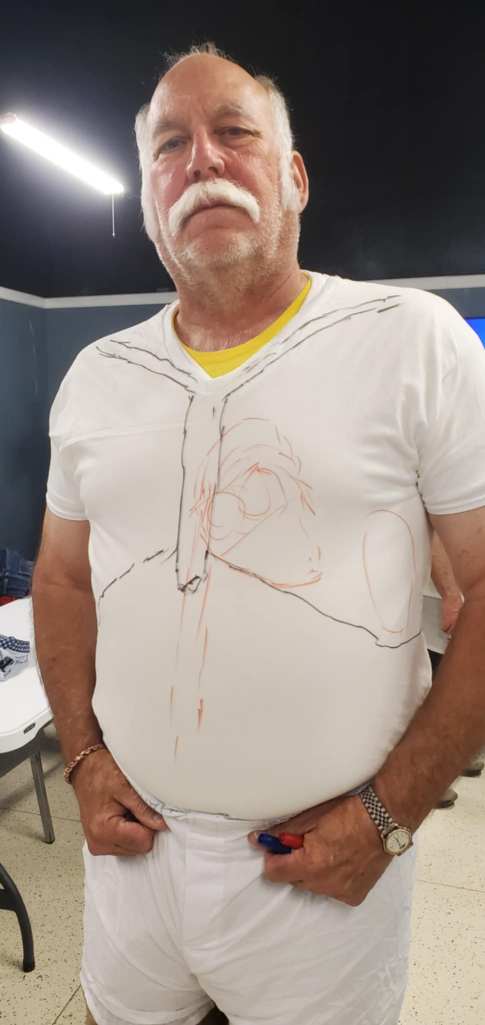
The balance of the day was spent back in the classroom with students working in pairs and with washable fabric markers, to draw relevant body structures on tight white tee shorts and boxers we were instructed to bring. The humor of it aside, as everyone had a fun time doing it, this exercise really brought home the concept of visualization as building the physical model helps create and maintain the cognitive model we must use in the field. This part of the lecture really drove home Doc’s mantra of “surface landmarks are bad.”
After an 11.5 hour working session, with comfort breaks of course, we adjourned for the day. I was truly brain tired which, given the amount of information we consumed, was not surprising.
TD2
We reconvened in the classroom on Sunday morning opening with a review of TD1, then a deep dive on anatomy and the body’s response to traumatic injury. This got a bit technical, for a lay person, but was highly informative. That led into a review of what bullets do inside bodies and reaffirmed, for me, that pistol bullets are physically incapable of doing what a lot of commenters on the Gunternet think they do. Placement of shots with pistol bullets is the absolute critical path, and penetration of those bullets to fight stopping structures and organs is a close second. Everything else, particularly bullet expansion, becomes trivial.
From there we moved into a long discussion on the ethics. There really is a moral dilemma at the center of lethal force, and a natural phobia to violence, which must be addressed by the individual as part of establishing their mindset. Doc spoke to this marvelously using the Hippocratic Oath that physicians take as a key point. A principle canon of medicine is to first do no harm, and a physician must often act under the doctrine of competing harms where the least harmful action is typically the best path forward.
The real learning here, from my notes, is that as instructors we will be instructing our students in techniques proven to increase mortality in violent criminals during justified uses of force. That, without question, is doing harm. But that higher rate of mortality translates directly into a lower rate of morbidity and mortality for officers and private persons. That is the doctrine of competing harms in action. That simple analysis assists in resolving the moral conflict and can, I believe, help get the student into the correct mindset.

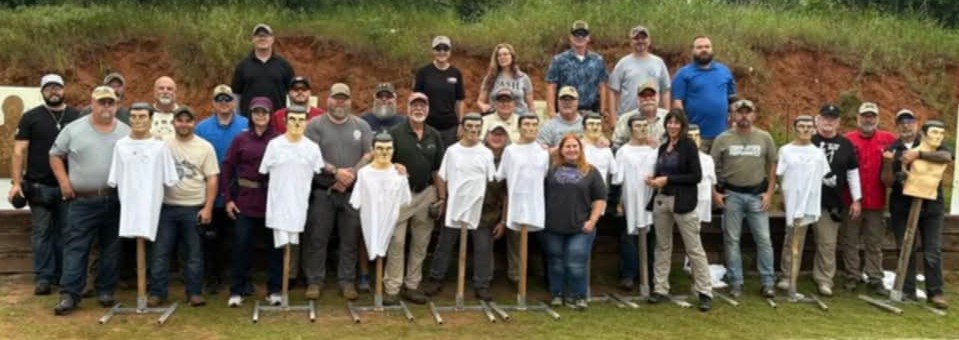
Then it was off to the range for live fire. Working with 3D targets; unmarked white t shirts on the torsos and white panty hose on the heads, we worked at delivering shots to two of the three “zones of incapacitation” we had learned in lecture, but with the target in various aspects between 30 and 120 degrees off facing us directly. We broke into three relays and David Maglio from Massad Ayoob Group ran the line with both discipline and efficiency. A close quarters technique for delivering surprise hostage rescue shots to the brain stem was demonstrated and run, then torso shots to the cardiac area from 7 yards. Doc Williams assessed each student individually, with Chuck Haggard assisting as a coach.
When all was said and done, I had fired 24 rounds. Not a lot for a shooting class but, as Doc informed up front, this is not a shooting class. The visual feedback from putting rounds on a three dimensional target at a variety of presentations was solid gold.
The afternoon’s lecture was spent on the capabilities of simulator training as relates to applying the cognitive model. Force on force training as a modality to reinforce anatomically correct targeting skills was also discussed. Then each student, with a partner to critique / coach them, had the opportunity to run a scenario on Meadhall’s Smokeless Range simulator, operated by Meadhall head honcho Bill Armstrong. Each student ran a unique scenario, and the instant feedback was invaluable.
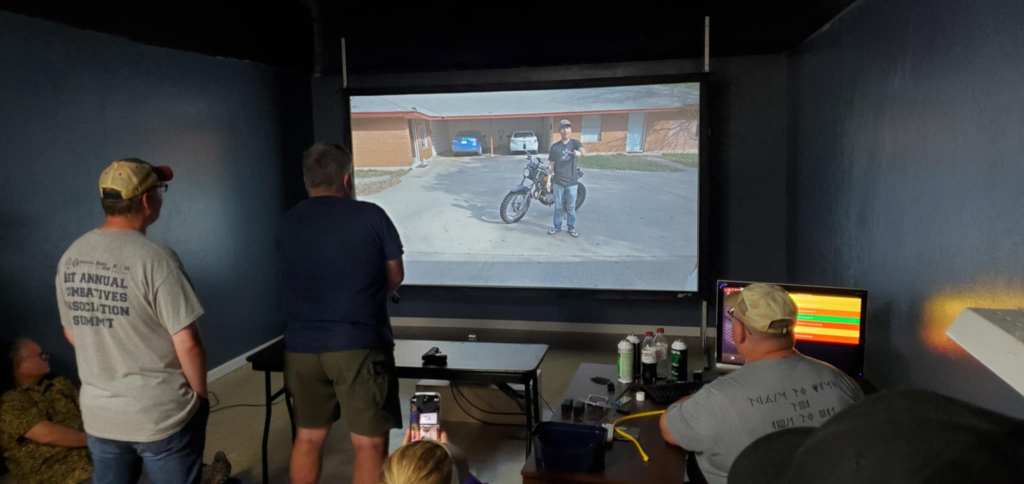
It was interesting, coming at the end of the course, how many of the students were attempting precision head shots when hits to the anatomically correct points in the high torso were, in most scenarios, certainly a better option. In the scenario I ran the “suspect” only offered his head as a viable target, at an awkward angle and well below my eye level as he was seated in a car. I delivered a single deliberately placed shot that was judged to be in a correct orientation to make a hit on the “suspect’s” brain stem, without relying visually on external landmarks. Such a hit is instantly fight stopping in the real world. I visualized the structure within the body and put a shot to that point, demonstrating the essence of Shooting with Xray Vision.
Wrapping up
On balance this was an excellent example of “train the trainer” instruction, thoroughly grounded in adult learning theory. Each student left with a flash drive with the full Power Point presentations from the course. Doc Williams also provided a short, but authoritative, reading list for further study. Several of the titles I already have on my reference shelves, and I will soon be digging into the remainder of the list. All of us who participated are well prepared to mold the key elements of Doc’s methodology into our own curriculum and we should as real world results prove the rightness, and the value, of his concepts.
This course is only offered annually, is restricted to certificated instructors, and is only offered at Meadhall. Doc was clear that, like the rest of us, he is getting older. The amount of effort that goes into the course is readily apparent and it is not something he will be able to do forever. But by offering the course, and spreading the knowledge, the proven fight stopping techniques will carry on.
One example is the Tactical Anatomy Summit, a two day open enrollment class which is being offered two to three times a year at venues around the country.
Finally, a note of thanks to our host. The Meadhall Range facility is, without question, one of the best around. From the modern, comfortable, multipurpose classroom to the real bathrooms on the range, Bill Armstrong has left nothing to chance. This is my third visit to the facility, and I am sure it will not be my last. Meadhall is just east of the Oklahoma City metro area and attracts some of the best instructors in the business. Any class you take these will be a positive experience.


 SRF Training and Consulting LLC
Leave a reply to Ed Barton Cancel reply