
Lately, in a number of social media groups I follow which are focused on defensive firearms, there have been spirited debates about ready positions with a handgun. Like a lot of topics on social media everyone involved seems convinced that they are right.
Identifying an issue
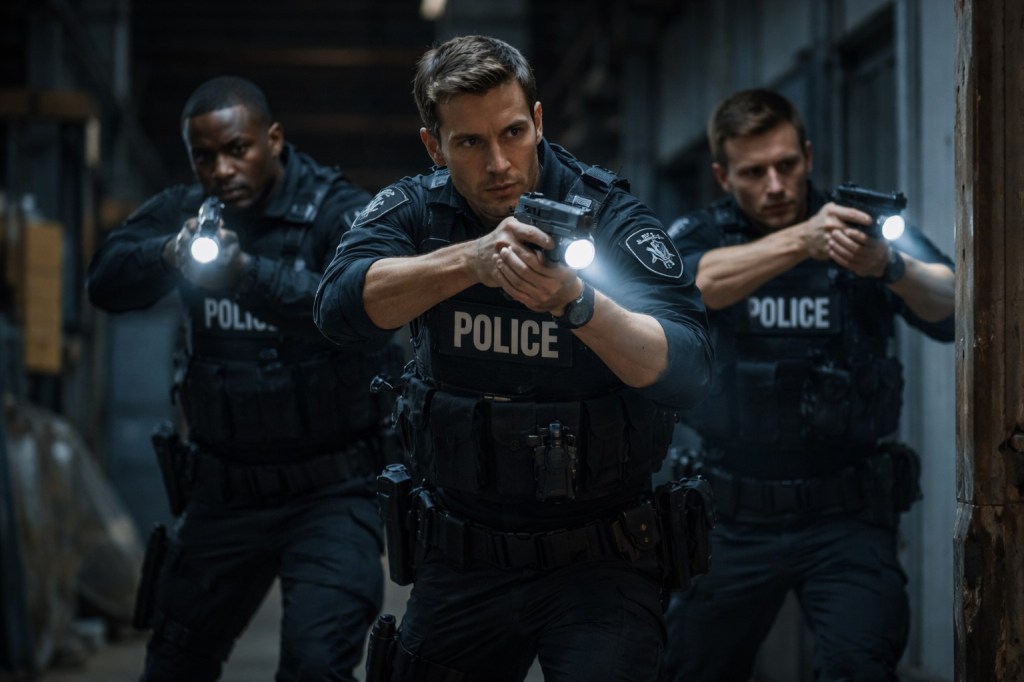
A few years back nationally recognized trainer Erick Gelhaus penned an article for American Cop magazine taking a deep dive on ready positions as they relate to law enforcement. The article references a study by Dr. Paul Taylor first published in 2020 that specifically measured officer’s perception and response times from various ready positions. The goal was to reduce what are labeled as “mistake of fact” shootings.
A “mistake of fact” shooting is one where an officer, or a private person for that matter, mistakenly believes that a situation poses a threat, leading to the use of deadly force against an individual who is not actually armed or dangerous. Perhaps not surprisingly, as much as 25% of law enforcement shootings can be classified as “mistake of fact”.
The results of Taylor’s research were illuminating. His report showed that lower ready positions allowed officers to better see and more readily identify impending threats. Concurrently the study established that the difference in time between recognition of imminent lethal threat and shot fired was so small that it is generally meaningless.
There is also a growing body of case law holding that officers pointing guns at people without justification for lethal force in the moment is outside the boundaries of the Constitution. Despite that, and the pile of scientific evidence, many officers still believe that confronting potentially dangerous suspects, or searching for them, with no lethal threat positively identified yet, can only be done with the gun raised to eye level.
Hence the debate. But what does this mean for the private person defender?
You’re not a cop
The context of law enforcement and private person defender are vastly different. When I was doing police work my job was to look for trouble and deal with it appropriately wherever I found it. As part of that job, it was understood that the use of force to compel an arrest or to defend myself or a third party was a thing. In order to do that my actions were indemnified by my employer so long as the actions I took were reasonable at that moment and conformed to policy and the law.
As a private person, my goal is to avoid trouble. I am not hunting felons when I go to Walmart for a case of water and some batteries. I have no duty to arrest or intercede. Most importantly, no one is indemnifying my actions but me. If I make a wrong decision, I risk prison, civil penalties and my life being ruined.
For private persons, pointing the muzzle of a firearm at another person without justification to use lethal force is a crime in every state. Here in Wyoming, we regularly see cases of people catching a felony charge for pointing firearms when it wasn’t warranted. These can escalate into “mistake of fact” shootings, with sometimes tragic results.
Being ready
When we are in a situation that we evaluate as potentially threatening, and that can not be avoided or evaded, the decision model of ‘could, should, must’ comes into play.
- Could I take an action?
- Should I take an action?
- Must I take an action?
We could take an action, of course, at any time. But it becomes incumbent upon us to determine the proper action within the context of the moment. The experiences noted in the linked articles validate that switching to guns by default is not always a good path.
We should take an action because the threat is encroaching and we may have to defend ourselves. Then we might draw to ready and issue some verbal commands while seeking cover or concealment.
We must take an action when the threat is imminent and is lethal to us or another person, and there is no other choice. When we evaluate the situation that way its time to put sights on target and finger on trigger.
It is within the span of could and should where ready positions can be used and are useful.
Doing it the right way
In my curriculum for both private persons and armed professionals I teach three essential ready positions. I teach three because three is easier to remember than four, and because these are the best commonly used methods. I also teach a subset of hand configurations. Each is intended to avert the muzzle off people that should not be muzzled. Each affords an unobstructed view of the threat. Each will also support movement, and driving the gun out to a firing position is both natural and fast.
Low Ready – this position offers the widest range of use. No matter how near or how far I am from a threat, the muzzle is pointed at the ground at the feet of the threat. I can clearly visualize the threat from the waistline up. In this photo, I have placed a target seven yards away. The muzzle is aimed at the ground at the target’s feet. As the evidence from the Taylor study shows I can raise the gun to a firing position and begin pressing shots nearly as fast as I can with the muzzle held on the target’s torso.
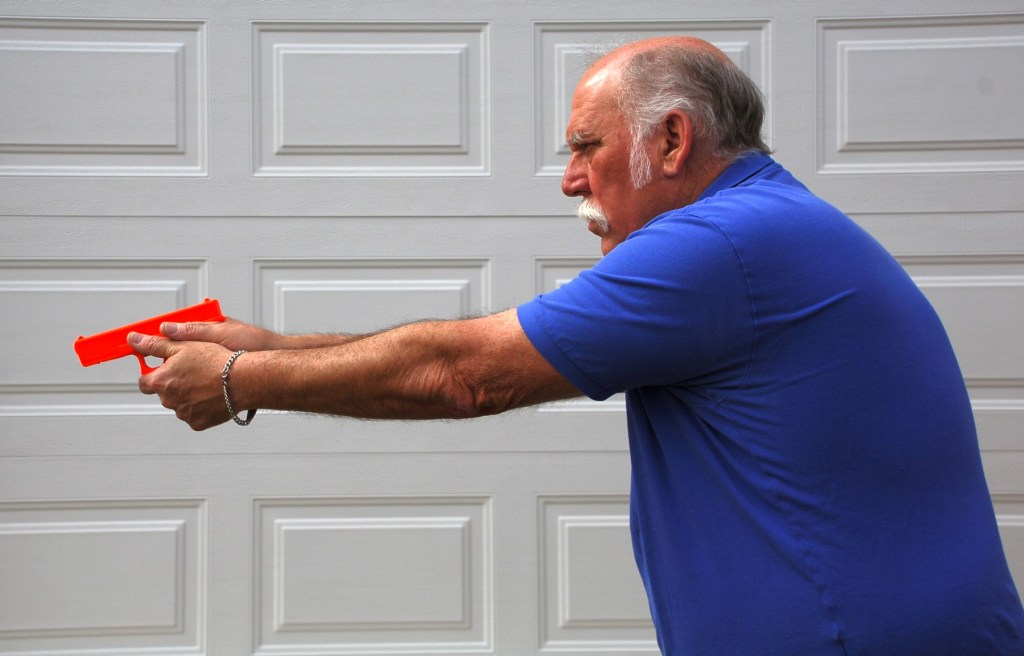
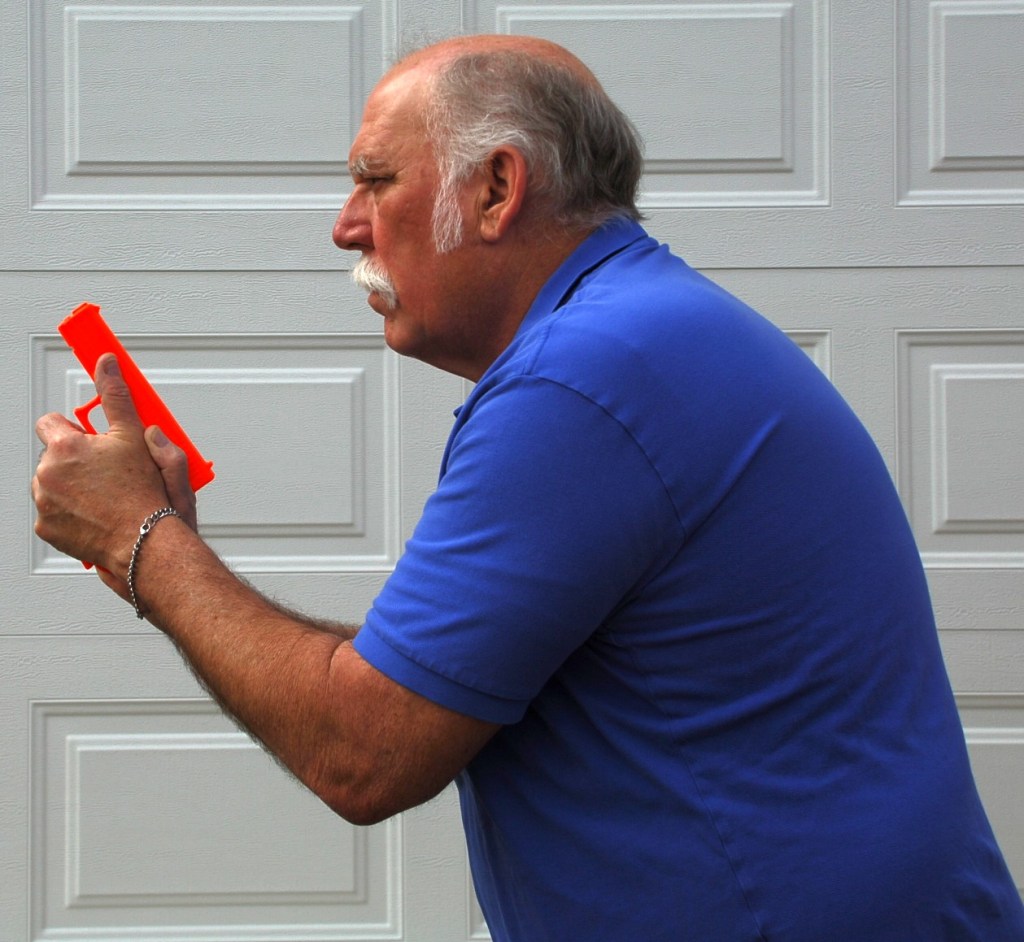
High Ready – this position is useful in a crowded environment; a church, school, or shopping mall where you may be surrounded by people, particularly children, who are likely to be moving or attempting to get on the floor to make themselves less of a target. There is, potentially, a minor limitation to visibility of the threat, but proper technique mitigates the risk. The benefit of muzzle avoidance outweighs any slight limitation.
Compressed Ready – this position is most useful when you are at close quarters. I prefer to use it any time I am between six feet to within arm’s reach from the target. At arm’s reach I will move to retention which is not shown. I find compressed ready is well suited to working around cover when the conditions do not allow stepping back from the cover. That helps us to not “lead with the gun” when pieing around the cover. It is also effective when moving.
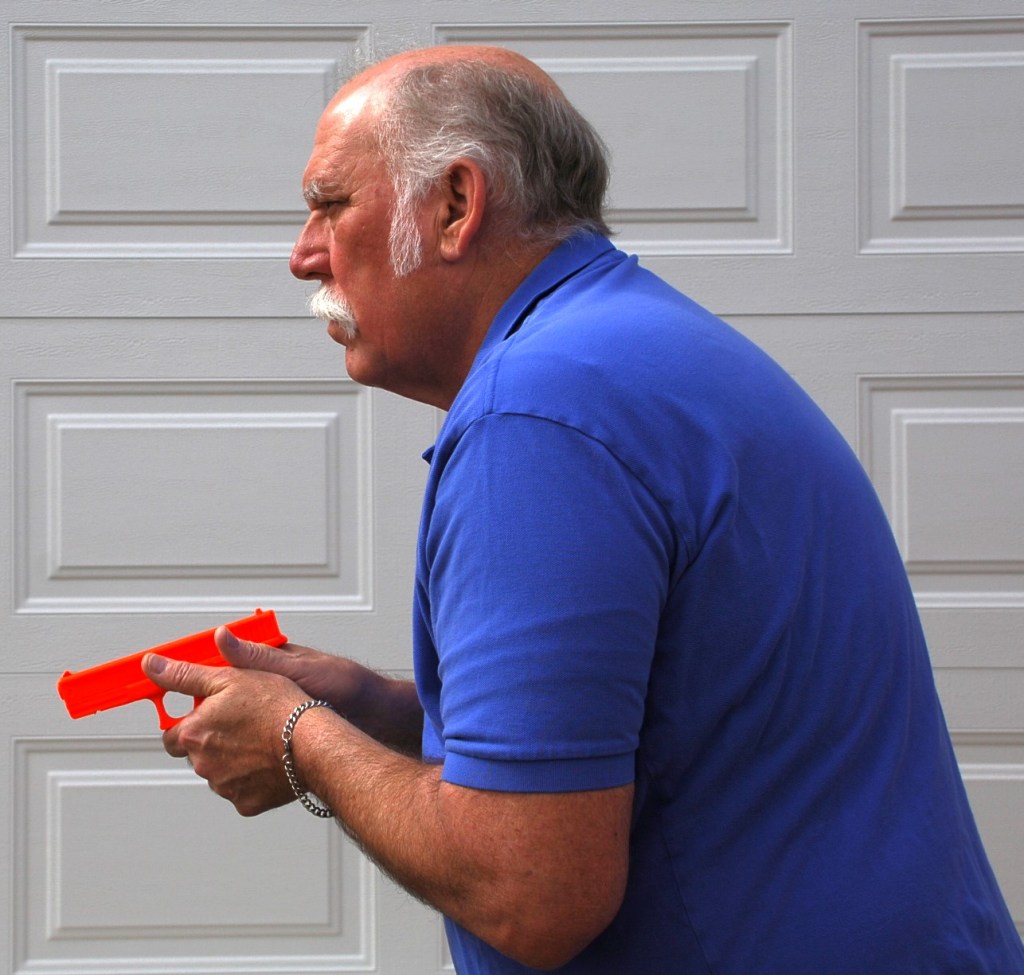
With compressed ready it is important to build the muzzle averted posture shown here. I see far too many people performing compressed ready with the bore parallel to the ground, which is exactly what we want to avoid.
Hand positions
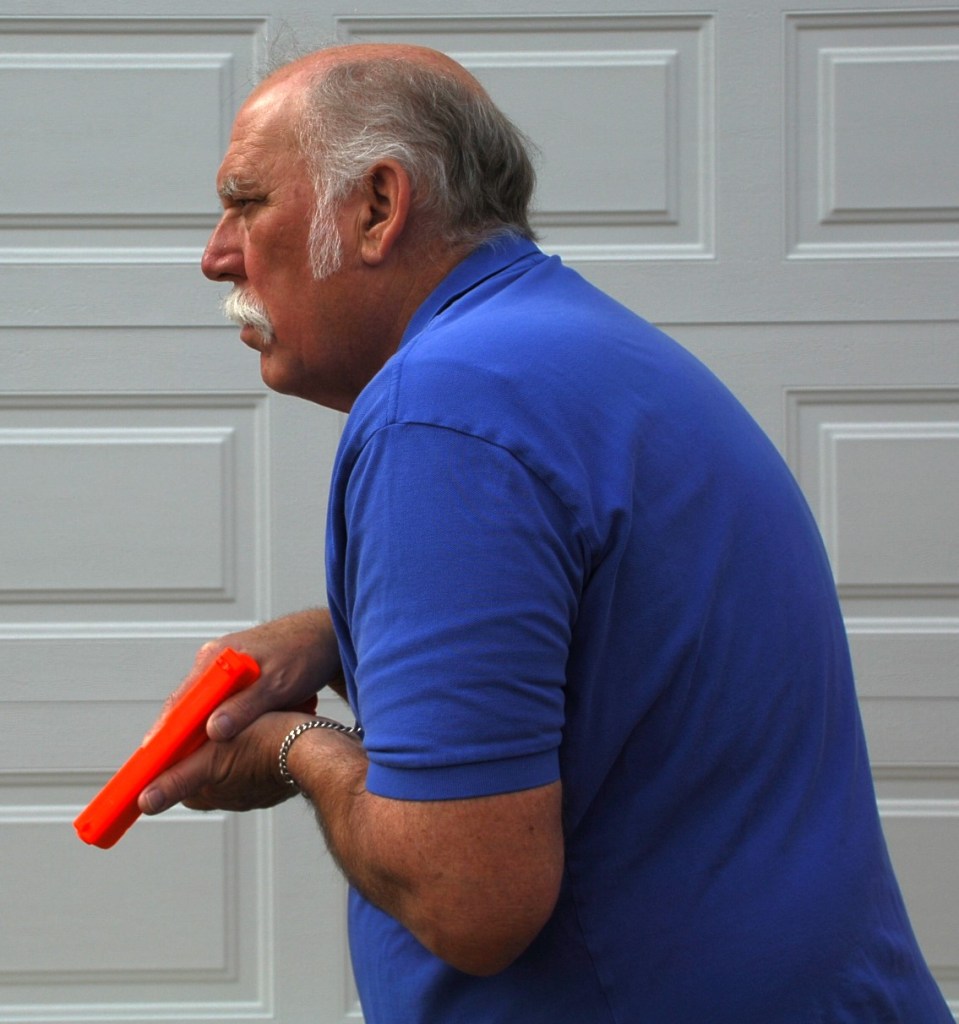
Position Sul – Some view this as a ready position, and I am told there are any number of law enforcement instructors teaching it that way. I disagree. I would submit that driving the gun out to firing position from Sul is not at all a natural movement. The hands have to negotiate three axes in the movement. I find Sul best suited for movement from cover to cover and averting the muzzle as we go. Once we arrive where we need to get to, revert to the most appropriate ready position for that moment.
Often, I see practitioners of Sul with the muzzle more vertical. But to do that would require me to break my firing grip. Maintaining the firing grip at all times is a critical path item, and breaking down the grip is best avoided. This is a case of making a technique work for me.
Muzzle Down – I first learned this technique from Darryl Bolke; lawman, instructor, and student of the history of firearms and fighting with them. Criminal attacks, particularly active shooter situations, often happen in crowded places. Once the crowd perceives a threat, and particularly when shots start going off, people are going to start moving rapidly. It becomes incumbent to not cover them with a muzzle while we work to engage the threat.
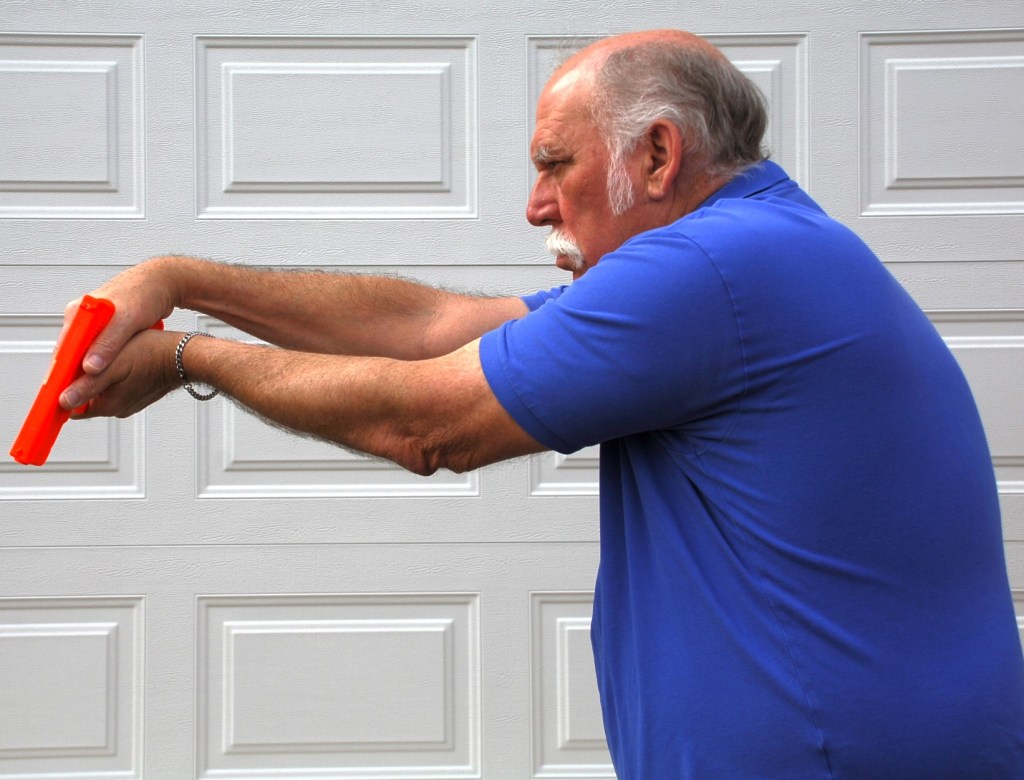
The muzzle down technique involves simply hinging the firing hand wrist down 90 degrees. This averts the muzzle away from people who, in Darryl’s words, do not need to have guns pointed at them. It works equally well in low ready and compressed ready, or with the gun extended out to fire as shown here.]. From compressed ready this technique puts the gun in Position Sul and sets up moving safely.
Wrapping it up
For both armed professionals and private person defenders the evidence is abundantly clear. Muzzling another person without a clear and imminent threat of death or great bodily injury, is not reasonable. The risk of a mistake of fact shooting, litigation, or criminal charges for the private person, far outweighs any fractional gain in speed.
The actions we take are going to be judged primarily by whether or not the action was reasonable. In that light, the need for responsible muzzle discipline becomes mission critical. It can not be ignored for mere expediency.
Photo credits — Police searching created in Grok, Switch screen grabbed from Top Gun, all other photos by author.
 SRF Training and Consulting LLC
Leave a comment