
Two years ago, a small, invitation only, event was held that gathered some of the best and brightest minds on use of the shotgun for defensive and combat purposes. It has grown a bit since then.
That first event evolved into the first open enrollment Thunderstick Summit held last year in Las Vegas, hosted by Vang Comp Systems with support from corporate partners like Mossberg, Kick-Eez, 5.11 and Airidus Industries. I attended that event, along with 75 or so other dedicated shotgunners and it was three days of deep immersion training facilitated by a cadre of luminaries in the world of defensive shotguns. That the event was a success, is borne out by this year’s second edition held October 11-13 at the FARM Training Center in Fairfield Utah.
Training Day 1
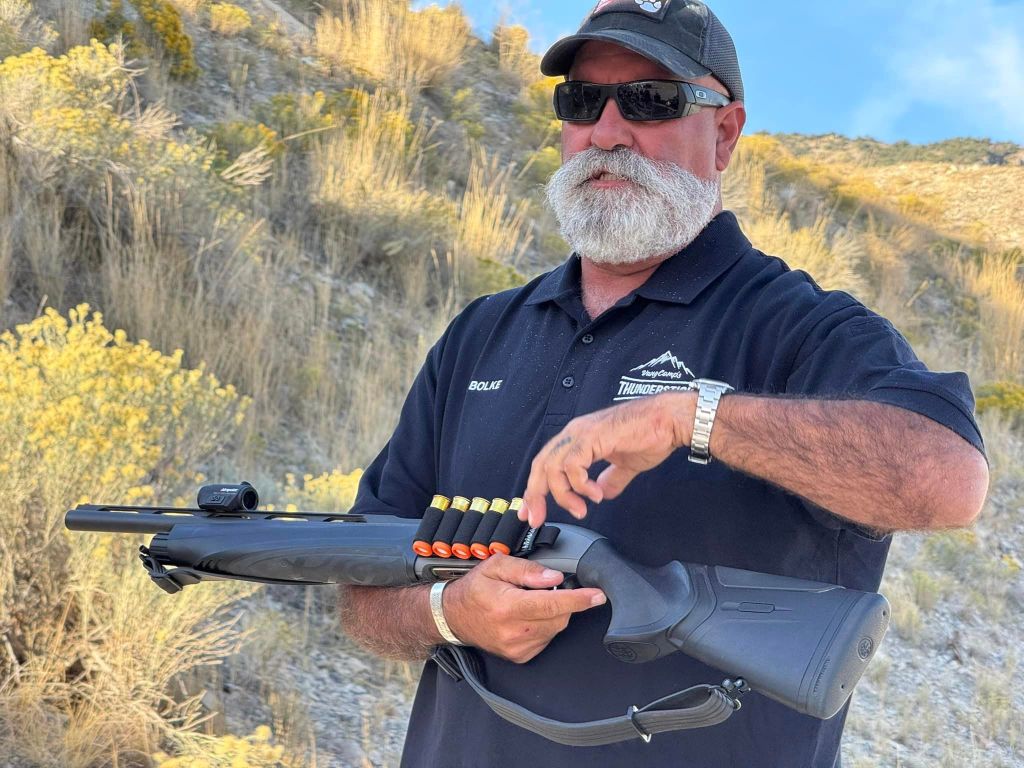
Arriving at 8 AM on day one 90 students gathered to be greeted by one of the creators of the event, Darryl Bolke of Hardwired Tactical Shooting. DB, as he is most commonly referred, is a retired police officer who has been working as a trainer in both the public and private sectors for well over a quarter century. His mantra of accurate and precisely accountable shooting is one that many who focus solely on “going fast” should take to heart. After introductions from the instructor cadre and delivering his signature safety brief, DB outlined changes from last year’s event.
An a la carte training calendar was provided in advance and sign ups were offered prior to the safety brief. This was where the biggest change was quickly apparent. At last year’s event the offerings were broken into a pair of two hour blocks in the morning and another in the afternoon of each training day. That proved to be inefficient as participants had to transition between instructors on various ranges and it cut deeply into training time for some. This year, DB explained, there would be one three hour block in the morning and another in the afternoon each day.
Following the brief, Mark Fricke of American Firearms Training and Tactics led a session for all attendees that could best be thought of as “Shotgun 101”. For the experienced shooter it might on face seem redundant, Mark walked through the history and development of both guns and ammunition while weaving in use cases and relevant real world experiences to illustrate both the benefits and the drawbacks of the fighting shotgun.
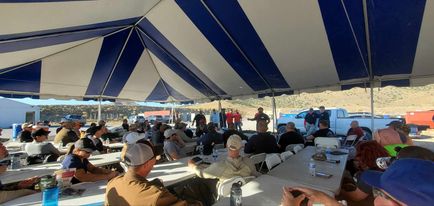
Following lunch, the first timers went with Mark to a range for Block 1 of his Fundamentals course. The balance of students spread out among the rest of the cadre to knock off any rust on their skills with a refresher on administrative handling, patterning, basic drills, and gear validations. We were encouraged to train with an instructor that we had not signed up for. Each instructor has their own take and style of delivery, the idea being to get a more rounded picture. I chose to work with Erick Gelhaus of Cougar Mountain Solutions.
Erick and I chewed some of the same dirt in Northern California law enforcement but had never met until we shared a range in a Rangemaster Instructor Development course a few years back. I had trained with him at last year’s Thunderstick on his “West Coast 12 gauge” block as well as in a low light session he taught along with Steve Fisher of Sentinel Concepts.
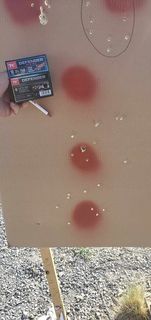
Using one of my 870P model guns equipped with a Vang Comp modified barrel the rust I had came off pretty readily within a box or so of Federal Top Gun birdshot. Knowing that this gun patterns exceptionally well with Federal Flite Control buck shot, I took the opportunity to pattern it with Winchester’s 9 pellet 00 buck shot offering from their Defender line. This loading uses copper plated pellets in a one ounce AA wad at an advertised 1145 fps. It was quite mild in recoil and delivered good patterns. In the photo the pattern at top left was five yards, top right at ten yards, bottom at fifteen yards and the middle at 20 yards. Given how hard it is to find Flite Control at times I would have zero qualms with the Defender load in that 870 within my home and on my property out to 25 yards. We were wrapped up and released by around 4 PM.
Training Day 2
The instruction began in earnest with each instructor delivering two blocks of their content, one in the morning and one in the afternoon. Mark Fricke led block 2 and 3 of his Fundamentals course. DB ran an offering focused on manipulations called “Feed the Pig.” Steve Fisher led blocks on Positional Shooting. Greg Ellifritz of Active Response Training offered a block on Cornering, Cover and CQB. Rounding it out Rob Haught and his son Matt from Sym-Tac Consulting delivered instruction on their signature “Push-Pull” recoil management technique. As I have trained with Fricke, the Haughts and Fisher in the past, I opted to spend the morning with DB and the afternoon with Greg.
With as much experience as I have on the gauge, going back almost 40 years private and public, manipulations might seem to be a ho hum, put a check mark in the box, kind of course. I have found as I age that my arthritic hands do not always want to cooperate, and I am always looking for new ways as “That’s How We’ve Always Done It” does not fly with me. Working through a series of shoot and load evolutions, DB suggested that loading from the right hand into the right handed gun might be a better way. He tipped to it watching his wife shoot clays and it dawned on me that when I am shooting clays, I do the same thing. I have done it hundreds of thousands of times and all at once the Violin method of tactical reload into the magazine tube made perfect sense.
After lunch I moved to a small range next to a shoot house for Ellifritz’s session. This course was done entirely dry, with multiple visual verifications and a partner pat down to ensure no live ammo present. I had done this same block last year but as I looked at my notes before this year’s event and worked through some of the learning points at home, I felt like a refresher was in order. Working with a partner Greg walked us through slicing the pie backed away from cover, lunging out in increments if necessarily close to cover and how to deal with hard corners in buildings. We spent the final third of the period in the shoot house, still dry, looking at how to anticipate, identify and resolve issues while working inside a building with a deployed shotgun.
That evening the team of Gelhaus and Fisher again facilitated a low light course, but I passed it this year. Giving others a chance and being pretty well done in by a long day of training in the desert heat made it a good decision
Training Day 3
The morning session of the third day took things up another notch. DB offered a Defensive Movement course (note for next year), Gelhaus led a dry Low Light Technique course in the shoot house, Fisher led a session on Dynamic Movement, Ellifritz taught weapon retention and disarms which was also a dry course, and the Haughts offered an advanced Push Pull session which included working Rob’s short stocking technique for close quarters. I chose to spend my time with Mark Fricke on shotgun delivered Less Lethal Munitions. This class was sponsored by Byrna, an industry leader in less lethal.
I have not had any training on Less Lethal since I left law enforcement more than a decade ago. Mark noted that while it is still largely a law enforcement tool less lethal is growing its presence in the private sector. The key problem with that is that a majority of the less lethal options available to normies come with exactly zero training attached. Some less lethal munitions can be quite lethal if used within their minimum distance and without any training an otherwise responsible homeowner could wind up in a bucket of trouble shooting someone with less lethal from too close a distance thinking it was non-lethal.
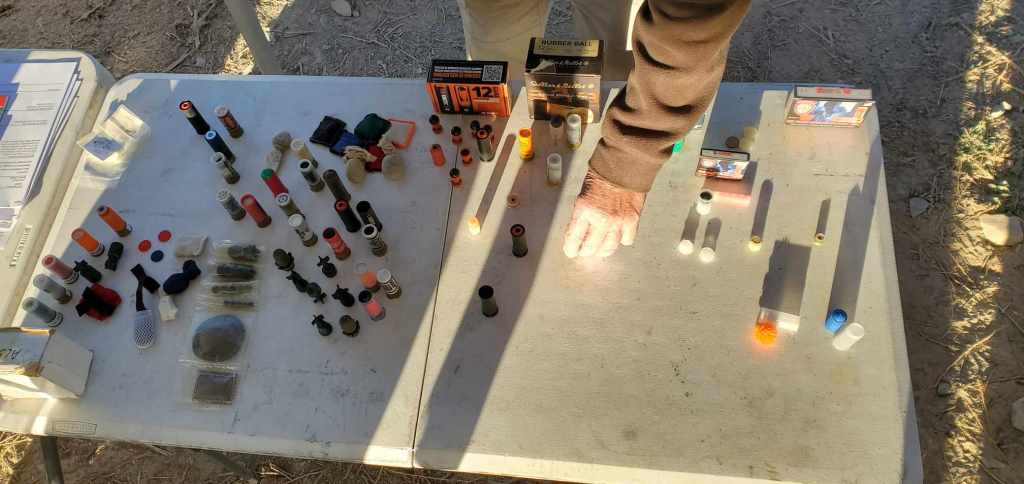
The subject interests me due to my living in Wyoming where apex predators and recalcitrant livestock are both very much a thing. Hazing those critters away from a distance, if possible, is a lot better outcome than being forced to shoot them at close quarters or, worse, in contact and taking your chances that it ends favorably to you. Longer term I will develop a less lethal block in my own defensive shotgun curriculum to give students a flavor of it and what is available to them if they choose to use it.
Mark began by walking us through some history of shotgun delivered less lethal including the various bean bag rounds with which I was most familiar in my own experience. He peppered the discussion with use cases, context, and his own personal experiences some of which I can only describe as painful to think about.
Stressing accountability is necessary with less lethal. If you are going to use it, it needs to be with a gun dedicated solely to it. Mixing ammunition types on a single gun is a recipe for disaster. Likewise, if less lethal is deployed it is best practice to have a second person right there with lethal force ready to go if the less lethal happens to not work.
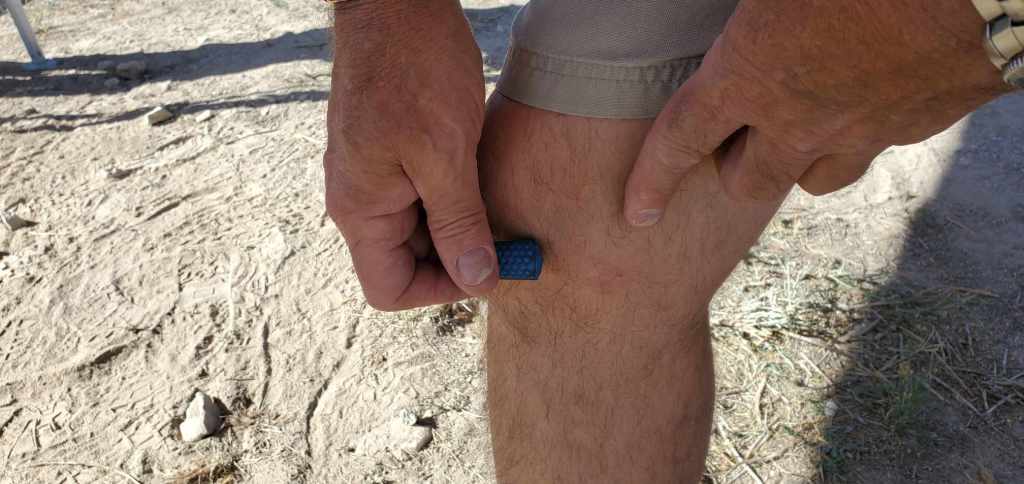
Following that the live fire commenced. Bean bag rounds make a very pronounced impression on ballistic vest panels, as do baton and rubber buck shot rounds. It is also worthwhile to note that rubber payloads, particularly baton rounds, like to come back where to where they were launched when fired against hard targets. We were shooting on steel targets at fifteen yards, and I watched a baton round I fired come cartwheeling back to hit me just below the knee. While there were no wounds, I certainly felt it.
This is where Byrna’s Kinetic offering shined. The fin stabilized projectile is accurate within 100 feet but being primer only powered it hits hard with less risk of skin penetration at inside the home distances. There is zero recoil and can be fired without hearing protection. We found a number of the projectiles and their sabots within a yard or two of the steel. I was quite impressed with both their offerings and their comprehensive training which Mark Fricke has helped with. Byrna is also developing a projectile that dispenses OC when it strikes a target, similar to the pepper balls we trained with in law enforcement. That has some real potential, I think.
Play Time
The afternoon of the third day, following an excellent, catered BBQ lunch is traditionally where the most fun can be had. In addition to vendor demos (Mossberg and Vang Comp offered live fire on some genuinely nice demo guns), the instructor cadre offered various qualification exercises and competitions. I shot the Prescott (AZ) PD qualification with Mark Fricke in a respectable 8.40, the par time is 10 seconds. I liked that drill so much I am going to incorporate it as the “swag shoot” in my defensive shotgun curriculum. I also fired the Ohio peace officer shotgun qualification with Greg Ellifritz… I and every other participant passed it. No Cop Left Behind; it is a thing.
DB ran an exercise that highlighted movement while addressing multiple targets but maintaining muzzle awareness and aversion so as to not cover non-threats. Muzzle aversion is one of his core concepts and one that he preaches relentlessly, and rightfully.
Then there was the Sym-Tac Coin Challenge, proctored by the Haughts. This is one of the spiciest exercises one can shoot with a shotgun and, to date, there are only 11 of their coins in the hands of shooters. The drill is simple; one IDPA target at 3 yards, one at 10 yards. The shooter starts with four slugs in the gun, safety on, at close quarters ready. On the go signal the shooter releases the safety, fires one to the -0 on the three yard target from a short stocked hold, then transitions the gun to the shoulder and fires three to the -0 of the 10 yard target, executes an emergency reload, and fires that to the head of the 10 yard target to stop the time. Pump gun par time is six seconds, semi-autos are five seconds and any shot that lands outside -0 or the head is a one second penalty. Matt Haught says that anyone who can run the drill under eight seconds is a competent shotgunner.
I had fired the drill clean at last year’s event in a decent time of 6.25 seconds, not good enough for a coin and due to struggling a bit with the reload. Like so many of this type, the drill is won or lost on the reload. This is, in part, why I took DB’s session on manipulations on day 1. I worked on them over the summer and was able to really polish it on the first day.
When my turn came, I turned in a coin worthy time of 5.85 seconds. Examining the target showed that I had put one of the three body shots at 10 yards about a half inch outside the -0 at 10 o’clock. The one second penalty meant “no coin for you.” Disappointing, but I know that I am capable of the coin and there is always next year.
Wrapping up
You will not find any more soup to nuts, deeply immersive shotgun training any place. Each of the instructor cadre are true SMEs with real world experience to back up what they preach and teach. Each of them brings pieces of their unique curriculum, and style, but nowhere else does it all come together under one tent. The shotgun has become something of a discarded tool; the high speed, low drag universe tends to ignore it, and law enforcement has, in some cases abandoned the gauge in favor of the carbine because of budget, that it is easier to train and officers don’t hate shooting a carbine like they hate shooting the shotgun. A big part of that hate is because they were never trained to shoot it right.
But the bottom line remains that the properly loaded shotgun is still the single most powerful lethal force tool anyone outside the military can bring to bear in a moment of truth. DB has said many times that if he had to go to a pistol fight tomorrow, he would be bringing a gauge.
And so would I.
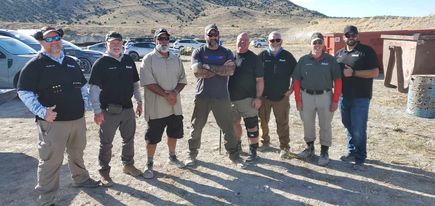
Many thanks to DB and his instructor cadre, shown below, for being “the light” on the shotgun. Thanks to Cody Stewart and his team at Vang Comp Systems for hosting and leadership. Herding 90 something students and eight world class instructors while providing rental guns and ammunition packages along with repairs on the fly is quite an undertaking. The corporate sponsors already mentioned, along with Wilderness Tactical, deserve a huge thank you for their support of this ongoing experiment in education.
Next year’s event promises to be bigger and better. I can hardly wait.
 SRF Training and Consulting LLC
Leave a comment