
One of the trends I see in a lot of training opportunities is that students can expect to send lots of rounds down range over the course of two to five days. While it can certainly build marksmanship skills, and be quite enjoyable, if all the student does is burn up a lot of ammunition running various drills what are they actually learning? It begs a question, are high round count classes actually teaching us things we need to know to succeed in a real world confrontation?
Early in my law enforcement career I learned that soft skills were the true key. It was one thing to learn how to grapple, use defensive sprays, properly swing a baton, hand cuff, or draw and shoot a gun. Much more important were things like how to measure up people and situations, how to assess and act appropriately when the potential for trouble or a threat is recognized. Equally important was how to communicate with people in crisis or who are intent on committing violence. All of these things were of greater importance than simply being capable of the measured application of force when necessary.
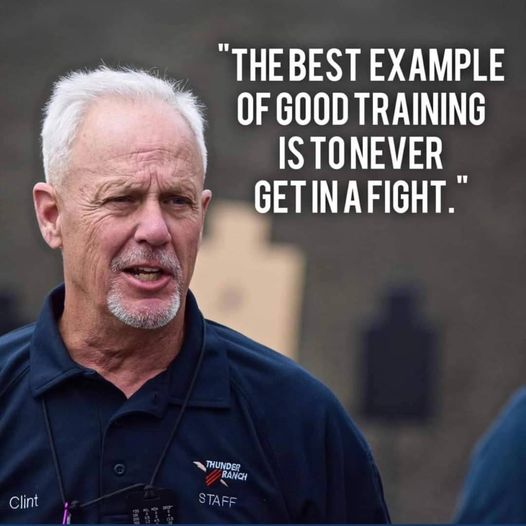
One of my earliest training officers gave me a piece of advice that I still use today with my own students… the fight you are 100% guaranteed to win is the fight you avoid. Recognizing danger in advance and responding in a way that avoids it are even more important for the citizen defender than the peace officer. As a personal defense instructor, I find that the notion of training to avoid fights first, while preparing to win them if there is no other alternative is the way.
Let the learning begin
To that end back in 2020 on the weekend that Covid-19 burst into public consciousness I had travelled to Arizona to work with John Murphy of FPF Training. Since then, I have stayed in regular correspondence with John and continue to tap his deep knowledge base with questions to help refine my own presentations. That 2020 course, Advanced Concealed Carry Skills and Tactics, was a smorgasbord of learning with about 700 rounds of live fire thrown in. Since I took that class John has continued to evolve and improve what is his flagship offering to encompass the more far reaching aspects of the curriculum that are in great part about those soft skills I mentioned earlier.
Recently I made a trip to Logan Utah and the Cache Valley Shooting Range to catch up with John and take his rebranded Street Encounter Skills and Tactics course. Operated by the Utah Division of Wildlife Resources, this facility is one of the best I have ever been to. On the Saturday that our class began the facility was hosting a large scale youth clay shooting tournament and was doing so without any perceptible impact on other operations.
As was the case with my previous experience the classroom session had been prefaced by close to ten hours of video presentations supplied by the instructor. These presentations, delivered in easily manageable chunks, represent the heart of John’s content. He presents a metric ton of material, backed by real world examples and lessons learned from the good, the bad and the sometimes ugly of personal defense in modern America. A significant part of the first day in the classroom was spent taking an even deeper dive into key learning areas from the videos presented in a way John describes as “safe, relevant and fun.” Many instructors would be well served, I think, to follow this teaching model as students come into class with a foundational understanding of the material and, very often, with questions at hand that are best answered through classroom discussion.
Making good better
One of the first and biggest changes noted is the round count for the class. For the weekend I sent a bit under 250 rounds from my Smith & Wesson M&P 9, with no stoppages or malfunctions of any kind. Overall, we fired about a third of what we did four years ago. Part of that is in response, according to John, to the various ammo shortages since Covid. But it is also because the curriculum has evolved to put much more emphasis on the mental aspects. It is important to note John’s own words that this is not a how to shoot class. It is a how to avoid a fight, but also a how to think if you have to fight, class.
The first day was spent in the classroom, which was good considering the cold spring rain that fell all day. Here I was able to compare and contrast the updated content. There were a number of areas where enrichment of the content was evident. An expanded section on pre-assault indicators, threat recognition and avoidance reinforced my own mindset and teachings on de-escalation and avoidance. An improved section on post-fight procedures and how to interact with law enforcement was also noteworthy, particularly the material on how to interact with a police dispatcher which, from my own experience in the business, was quite relevant. Trauma care, use of pressure dressings and tourniquets, and use of pepper spray were nice refreshers carried over from the previous content.
We spent the final portion of day one on the range… in the rain. While unplanned this was an excellent reminder that our fight, should it come, is not going to happen in optimal conditions. I found that while a military poncho kept me dry enough to not be miserable, it was a complete fail as far as getting a concealed handgun into action.
Where change was very apparent was when John introduced us to Rupert and The Determinator. The former is a 3D target in a form that should be familiar to experienced shooters. John has dressed him in a T shirt, put him on wheels and, using a rope and pulley system, Rupert, shown here at the center behind a kneeling John Murphy, can simulate a potential threat advancing at any pace. Combined with a variety of content voiced by John, Rupert can portray a casual panhandler to a hard charging attacker or anything in between. Combined with The Determinator, and with a nod to Shivworks Managing Unknown Contacts concepts, Rupert can evoke a wide range of potential responses from the student.
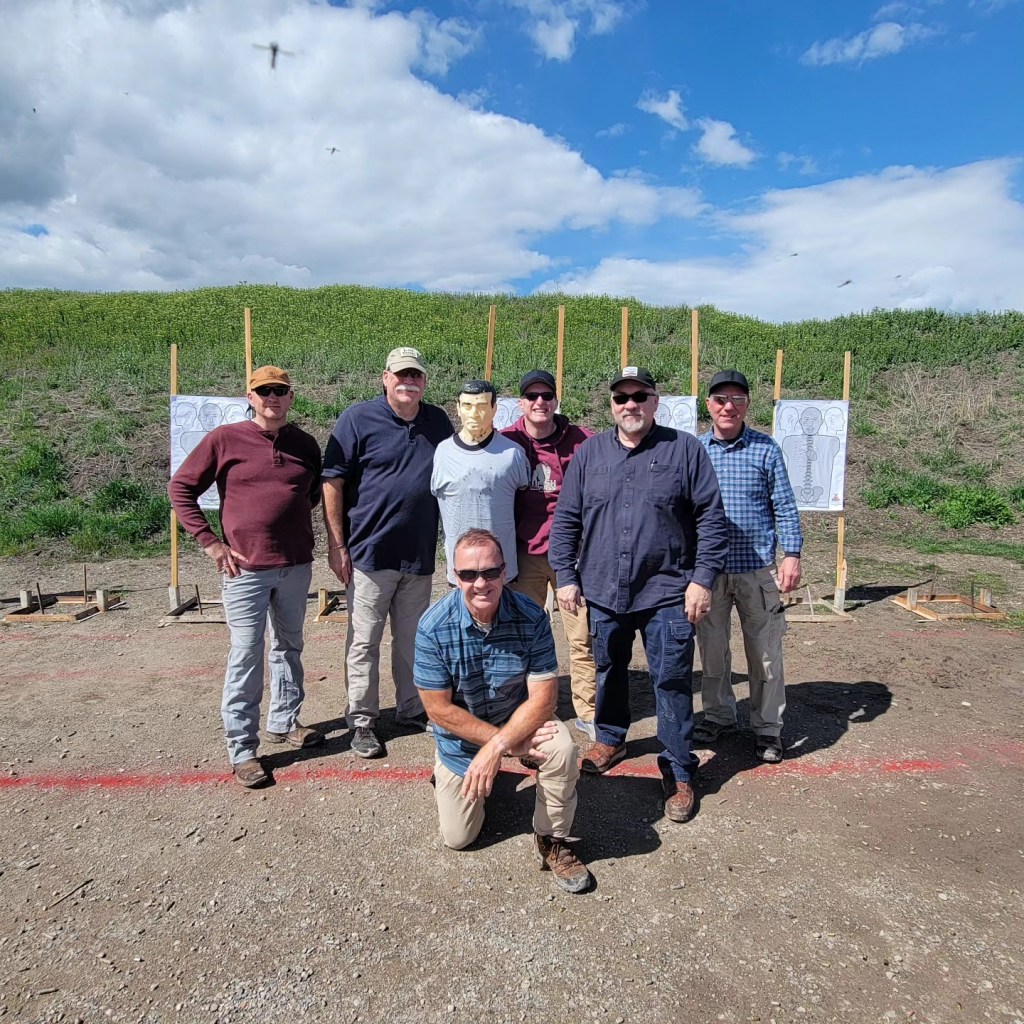
The Determinator, an invention of John’s, is a set of four handheld laser pointers banded together, with two reds and two greens. John has developed a series of combinations that when projected on target, be it a paper target or Rupert, give the student a visual cue about the appropriate action. Two greens, for instance, indicates a threat and that the student needs to shoot it. As the live fire exercises progressed students paired up and alternately, with one on the line and the other using a Determinator, they worked through a variety of scenarios with different outcomes. Not all of the scenarios ended with students firing shots. In some situations, verbal deflection or de-escalation was the correct solution, while in others students deployed pepper spray, using inert training devices. This was an exceptionally valuable series of exercises that put this iteration of the curriculum far above what I had experienced four plus years ago.
I do have to say that by the end of day two I was mentally tired which, according to John, is the desired result. This class is, truly, not about how or even when to shoot. It is about how to think your way through the worst possible day of your life, should that day come for you. It is about mental awareness and pre-planning responses to everyday encounters that any of us might have which are below the threshold of force, but which are capable of escalating beyond our control in an instant. It is about keeping your awareness and cognition at the highest level of your brain even when you are in the middle of an emergent threat, and being able to make considered, rational, decisions in a moment of truth.
Debrief
I came away with ten pages of notes, a bunch of bookmarked videos and a vote of self confidence in my own curriculum which emphasizes discretionary decision making and not letting our actions run faster than our brain can process what it is we are seeing. The use of visual cues is a winner, and it is where defensive trainers need to get to in the very near future.
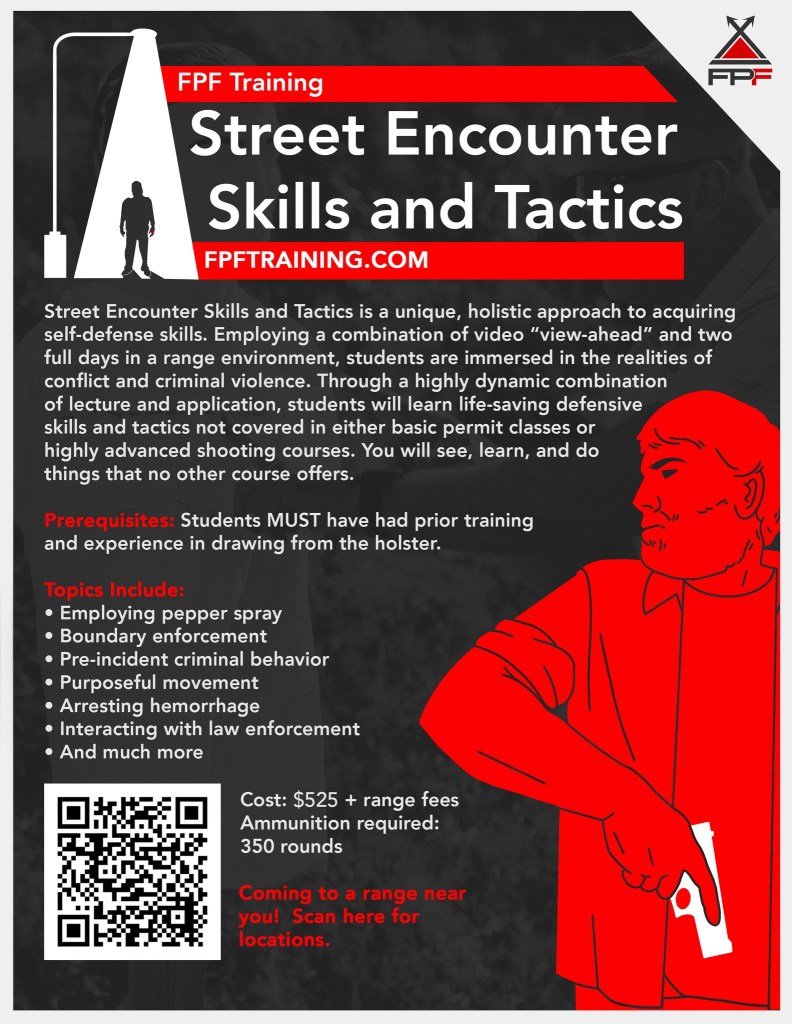
John Murphy, through his FPF Training operation, has put together a vital curriculum geared toward avoiding a fight, responding appropriately to perceived and potential threats, fighting efficiently and effectively if necessary, and how to deal with the aftermath that follows any use of force. In addition to traveling the country teaching his own curriculum, John periodically hosts nationally recognized trainers on a variety of subjects.
A weekend with John Murphy may not be as fun as sending a thousand rounds down range in a “high speed, low drag” offering. But it truly is training with a purpose far more important than chasing speed drills and range swag. If you are serious about the armed lifestyle, and you should be if you choose that path, then you need to attend Street Encounter Skills and Tactics presented by John Murphy.
Photo credits : Clint Smith quote sourced from Everyday Defensive Concepts, class photo and flier sourced from FPF Training.
 SRF Training and Consulting LLC
Leave a comment